WLAN
In the 802.11ac system, OFDM (Orthogonal Frequency Division Multiplexing) is used. Since the spaced subcarriers used to transmit data is equal in OFDM, the number of subcarriers in the 11ac signal depends on the bandwidth, shown in the table below.
|
Bandwidth (MHz) |
Number of Subcarriers |
Subcarriers Transmitting Signal |
|---|---|---|
|
20 |
64 |
-28 to -1 and 1 to 28 |
|
40 |
128 |
-58 to -2 and 2 to 58 |
|
80 |
256 |
-122 to -2 and 2 to 122 |
|
160 |
512 |
-250 to-130, -126 to -6, 6 to 126 and 130 to 250 |
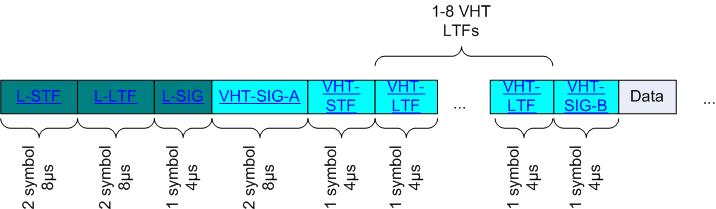
The frame format is shown in the following figure.
WLAN 802.11ac Frame
|
Frame Field |
Description |
|---|---|
| L-STF (Short Training Field) |
L-STF, starts with 'L-', which stands for Legacy, is L-STF (Short Training Field), which is similar to the same fields in 802.11a/b/g and 802.11n. The L-STF, along with L-LTF(Long Training Field), contain information that allows the device to detect the signal, perform frequency offset estimation, timing synchronization, etc. The 'L-' stands for 'legacy' and the details of the sequences used in these fields for the 20 MHz signals are the same as the legacy 11a and 11n preamble fields which allows for all 802.11 devices to synchronize to the signal. |
| L-LTF (Long Training Field) |
L-LTF, starts with 'L-', which stands for Legacy, is L-LTF (LongTraining Field), which is similar to the same fields in 802.11a/b/g and 802.11n. Fields are duplicated over each 20 MHz sub-band with appropriate phase rotation. Subcarriers are rotated by 90 or 180 degrees in certain sub-bands to reduce PAPR. The L-LTF, along with L-STF(Long Training Field), contain information that allows the device to detect the signal, perform frequency offset estimation, timing synchronization, etc. The 'L-' stands for 'legacy' and the details of the sequences used in these fields for the 20 MHz signals are the same as the legacy 11a and 11n preamble fields which allows for all 802.11 devices to synchronize to the signal. |
| L-SIG (Signal) |
L-SIG (Signal), starts with 'L-', which stands for Legacy, which is similar to the same fields in 802.11a/b/g and 802.11n. Fields are duplicated over each 20 MHz sub-band with appropriate phase rotation. Subcarriers are rotated by 90 or 180 degrees in certain sub-bands to reduce PAPR. L-SIG field includes information regarding the length of the rest of the packet. This means that all devices including the legacy devices will know that a packet of a given length is being transmitted. |
| VHT-SIG-A |
Fields in the packet beginning with VHT (Very High Throughput) are new to 11ac. The VHT-SIG-A field contains two OFDM symbols. It contains info required to interpret VHT packets (BW, number of streams, guard interval, coding, MCS, beamforming)
The legacy fields and the VHT-SIG-A fields are duplicated over each 20 MHz of the bandwidth and the appropriate phase rotation is applied. |
| VHT-STF |
VHT-STF is used to improve automatic gain control estimation in MIMO transmission. After the VHT-SIG-A, the VHT-STF is sent. The primary function of the VHT-STF is to improve automatic gain control estimation in a MIMO transmission. |
| VHT-LTF | VHT-LTFs, from 1 to 8 fields of the packet, are used for estimating the MIMO channel and then equalizing the received signal. Because the number of LTFs sent is greater than or equal to the number of spatial streams per user, they are called ‘resolvable LTFs’. |
| VHT-SIG-B |
Describes length of data and MCS for single or multi-user modes. Bits are repeated for each 20 MHz sub-band. The VHT-SIG-B is the last field in the preamble before the data field is sent. VHT-SIGB is BPSK modulated and provides information on the length of the useful data in the packet and in the case of MU-MIMO provides the MCS. (The MCS for single user case is transmitted in VHT-SIG-A.) Appropriate phase rotation is applied to each 20 MHz subband in the VHT-STF, VHTLTF, and VHT-SIG-B. |